An engineering leader walks into a board meeting. They have prepared slides showing deployment frequency improvements, test coverage gains, and a detailed breakdown of technical debt reduction across three services.
The CEO listens politely. Then asks: "Which of these will customers feel, and when?"
The engineering leader has excellent data. None of it answers that question.
This is the most common and most expensive communication failure in engineering leadership. Not a lack of information. A translation problem. The engineering team is doing important work. The executive team cannot see why it matters.
Every engineering leader will eventually face this gap. The ones who close it get resources, trust, and a seat at the table. The ones who do not get asked to "just give us the summary" and slowly lose influence over the decisions that shape the product.
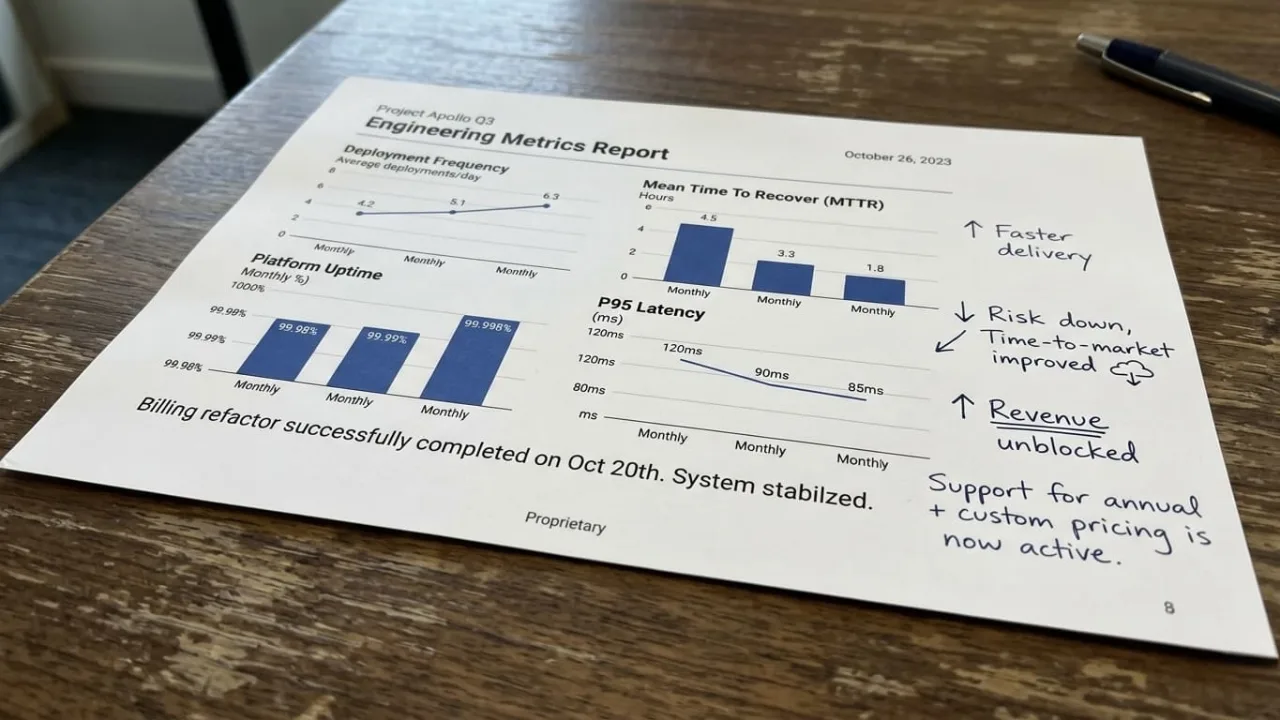
Why engineering and the executive team speak different languages
Engineering measures progress in system terms. Uptime. Latency. Deployment frequency. Code quality. These metrics are meaningful because they describe the health and capability of the thing the team builds and maintains every day.
Executives measure progress in business terms. Revenue. Retention. Time to market. Customer acquisition cost. Competitive position. These metrics are meaningful because they describe whether the company is winning.
Neither set is wrong. But they describe different layers of the same reality, and the connection between them is rarely made explicit.
When an engineering leader says "we refactored the billing system and reduced technical debt," the executive hears maintenance work with no obvious business consequence. When the same leader says "we can now support annual contracts and custom pricing tiers, which unblocks three deals sales has been waiting on since Q2," the executive hears revenue.
Same work. Different frame. Completely different reaction.
The five metrics executives actually care about
You do not need to abandon engineering metrics. You need to connect them to the metrics your executive team is already tracking. The specific emphasis shifts depending on company stage. A seed-stage CEO watching runway is focused on learning velocity and time to market. A growth-stage CEO is watching unit economics and retention. A late-stage CEO is watching margins, efficiency, and risk exposure. The five categories below cover the territory across stages, but the weight you give each one should reflect where your company actually is.
1. Speed to market
How quickly can the company move from idea to customer-facing feature? This is what deployment frequency, cycle time, and release process improvements actually affect. But "we deploy 12 times a day" does not land. "We can respond to a competitive move or customer request in days instead of weeks" does.
2. Revenue protection and expansion
System reliability, performance, and scalability are not abstract engineering concerns. They are revenue infrastructure. Downtime costs money. Slow page loads cost conversions. Scalability limits cap growth.
Frame reliability work as revenue protection. "Our uptime improvement from 99.5% to 99.95% eliminated approximately X hours of customer-facing downtime per month" connects engineering work to a number the CFO understands.
3. Cost efficiency
Infrastructure costs, team productivity, and build/buy decisions all have direct financial impact. Engineering leaders who can articulate the cost side of technical decisions earn disproportionate trust from the executive team.
This does not mean optimizing for cheapness. It means being able to say: "This investment in tooling will reduce our per-feature delivery cost by roughly 30% over the next two quarters, which means we can ship more with the same team."
4. Risk reduction
Executives think about risk constantly. Compliance exposure, security vulnerabilities, key-person dependencies, technical debt that constrains future options. These are all things engineering understands deeply but often communicates poorly.
"We need to address technical debt" is a request for resources with no clear payoff. "Our current architecture limits us to one new integration per quarter. Competitors are shipping three. This refactor removes that constraint" is a risk argument tied to competitive position.
5. Team capacity and leverage
Hiring is expensive. Attrition is expensive. Productivity losses from poor tooling or unclear processes are expensive. When engineering leaders talk about developer experience, career paths, and team health, they are talking about the most expensive line item in the engineering budget.
Frame it that way. "Improving our onboarding process from 6 weeks to 2 weeks means every new hire starts delivering value a month earlier. At our hiring rate, that is equivalent to adding two full-time engineers per year without increasing headcount."
Storytelling with data that drives decisions
Metrics alone do not persuade. Metrics inside a story do.
A story has three parts: context, tension, and resolution. Apply that to every engineering update you deliver to the executive team.
Context: "We are growing 40% year over year. Our current infrastructure was designed for the load we had 18 months ago."
Tension: "At current growth rates, we will exceed our database capacity within two quarters. When that happens, the customer experience degrades and we start losing accounts."
Resolution: "The migration we are proposing takes six weeks and positions us for 3x current scale. The cost of doing it now is planned. The cost of doing it as an emergency is 4x higher and comes with customer impact."
That is not a technical update. It is a business case with engineering evidence.
A word on honesty
Framing is not spin. Every reframe in this article works because the underlying connection between the technical work and the business outcome is real. Deploy speed genuinely does affect time to market. Uptime genuinely does protect revenue. Onboarding efficiency genuinely does affect team leverage.
If the connection is not real, do not manufacture it. If a refactoring project is primarily about engineering quality of life and only tangentially related to revenue, say that. "This investment makes the system easier to maintain, which reduces on-call burden, which helps retention, which protects our ability to deliver" is honest. "This refactoring will increase revenue by 15%" is not, and executives will eventually see through it.
The fastest way to lose the trust this article helps you build is to use business framing to justify work that does not actually have a business connection. When the connection is real, make it explicit. When it is not, be direct about what you are asking for and why.
Three rules for executive-facing data
- Lead with the business consequence, not the technical detail. The technical detail is backup material for questions, not the headline.
- Use comparisons, not absolutes. "99.9% uptime" means nothing to most executives. "We had 43 minutes of downtime last quarter compared to 6 hours the quarter before" tells a story.
- Tie every metric to a decision. If the metric does not imply an action, it does not belong in the executive update. Every number should help someone decide something.
When to push back and when to pivot
Not every executive request deserves a yes. Part of earning trust is knowing when to push back and doing it in a way that preserves the relationship.
Push back when the request trades long-term capability for short-term optics
"Can we just ship it without tests to hit the deadline?" is a question about risk tolerance, not engineering perfectionism. Your response should be in risk language: "We can ship without tests. The tradeoff is a higher probability of a production incident in the first two weeks, which will cost us more time than the two days of testing would."
Give them the tradeoff. Let them decide. But make the cost visible.
Push back when the timeline is a fiction
If someone promises a customer a feature in a timeline that engineering was not consulted on, that is a process failure, not an engineering failure. Address it directly but without blame: "The commitment was made before we scoped the work. Here is what we can deliver in that timeline, and here is what the full scope actually requires. Which version do we want to commit to?"
Pivot when the business context has genuinely changed
Sometimes the right answer is to drop what you are doing and respond to a new reality. A competitor launches a feature that threatens retention. A key customer is about to churn. A regulatory deadline moves up.
In these moments, the engineering leader who says "let me figure out what we can do" earns more trust than the one who says "that is not on the roadmap." Flexibility is not weakness. It is judgment.
The pattern: push back on process failures and invisible tradeoffs. Pivot on genuine business urgency. The difference is whether the pressure comes from poor planning or from reality changing.
Scripts for the hard conversations
These are not word-for-word scripts. They are frames you can adapt. The common thread is that each one translates an engineering reality into language the executive team can act on.
"We need to slow down to speed up"
Instead of: "We have too much technical debt and need to stop shipping features to fix it."
Try: "Our current delivery speed is declining because of accumulated system complexity. If we invest two sprints in the three highest-impact areas, our projected delivery rate for the rest of the quarter goes up by roughly 25%. Here is the specific plan."
"This estimate is real, not sandbagged"
Instead of: "It will take eight weeks."
Try: "Eight weeks covers the build, testing, integration with two existing systems, and a staged rollout. I can show you the breakdown. If we want to compress the timeline, here are the tradeoffs: we can cut scope to X, defer Y to a follow-up, or accept higher risk on Z."
"This is not a priority problem, it is a capacity problem"
Instead of: "We cannot do all of this."
Try: "Here are the six things we have been asked to do this quarter, ranked by business impact. We have capacity for four. I recommend these four, and here is why. If the other two are must-haves, we need to either extend the timeline or add capacity."
"The system is at risk"
Instead of: "Our infrastructure is fragile and we need to fix it."
Try: "We had three near-miss incidents last month that were caught by on-call before they became customer-facing. The pattern suggests the next one may not be caught in time. Here is the specific investment that addresses the root cause, and here is what the downtime would cost if we do not."
The other direction: translating business context to your team
This article has focused on communicating upward. But the reverse direction matters just as much.
Engineers make better decisions when they understand the business context behind what they are being asked to build. A team that knows "this integration is urgent because a $2M contract depends on it shipping by March" makes different tradeoff decisions than a team that hears "this integration is high priority." They scope differently. They push back more constructively. They find creative shortcuts that preserve the business outcome without compromising the system.
Translating downward means sharing context that engineering does not normally get: why this customer matters, what the competitive pressure looks like, how the revenue model works, what the board is focused on. Not every detail. Enough that the team can make informed tradeoff decisions instead of blind ones.
This is where many engineering leaders under-invest. They spend energy crafting the perfect executive update but relay priorities to their team as a task list with no context. The result is a team that executes but does not think. They build what they are told. They do not push back when the request does not make sense because they do not have enough information to know it does not make sense.
The best engineering leaders translate in both directions: business impact upward, business context downward. The upward translation earns trust and resources. The downward translation builds a team that can operate with judgment instead of just following instructions.
Why this skill matters more in 2026
First, engineering budgets are under more scrutiny. The era of "just hire more engineers" is over for most companies. Executives want to understand the return on engineering investment, not just the output. Leaders who can articulate that return in business terms will keep their teams funded. Leaders who cannot will face cuts that feel arbitrary but are actually the result of a communication failure.
Second, AI is changing the conversation about engineering productivity. Executives are reading the same articles about AI replacing engineers and 10x productivity gains. Engineering leaders need to be able to have a grounded, honest conversation about what AI actually changes in their org: where it helps, where it does not, and what the real productivity impact looks like in practice rather than in headlines.
That conversation requires exactly the same skill: translating engineering reality into language the business can act on.
The takeaway
The gap between engineering and the executive team is not a knowledge gap. It is a translation gap. Engineering leaders who close it earn trust, influence, and resources. Those who do not, slowly lose all three.
You do not need to stop being technical. You need to start framing technical reality in terms of business outcomes: speed, revenue, cost, risk, and team leverage.
The best engineering leaders combine deep technical credibility with the ability to make the executive team confident that the engineering organization is pointed at the right problems. Technical depth without communication is invisible. Communication without technical depth is empty. The leaders who earn a seat at the table bring both.
One thing to try this week
Take your next engineering update to leadership. Before you present it, rewrite every metric in the format: "[Technical fact] which means [business consequence]."
If you cannot complete the sentence for a metric, it does not belong in the update.

